
Will AI transform or disrupt GBS/SSC/BPO in Europe? What leaders must know in 2026
The question every GBS/SSC/BPO leader is asking in 2026
Across Europe and the World, executives running GBS, SSC, and BPO operations face the same uncertainty: is AI a tool that will help them deliver more value—or a disruptive force that will shrink their teams and challenge their relevance?
The answer, as it turns out, depends heavily on timeline expectations, investment choices, and operational readiness.
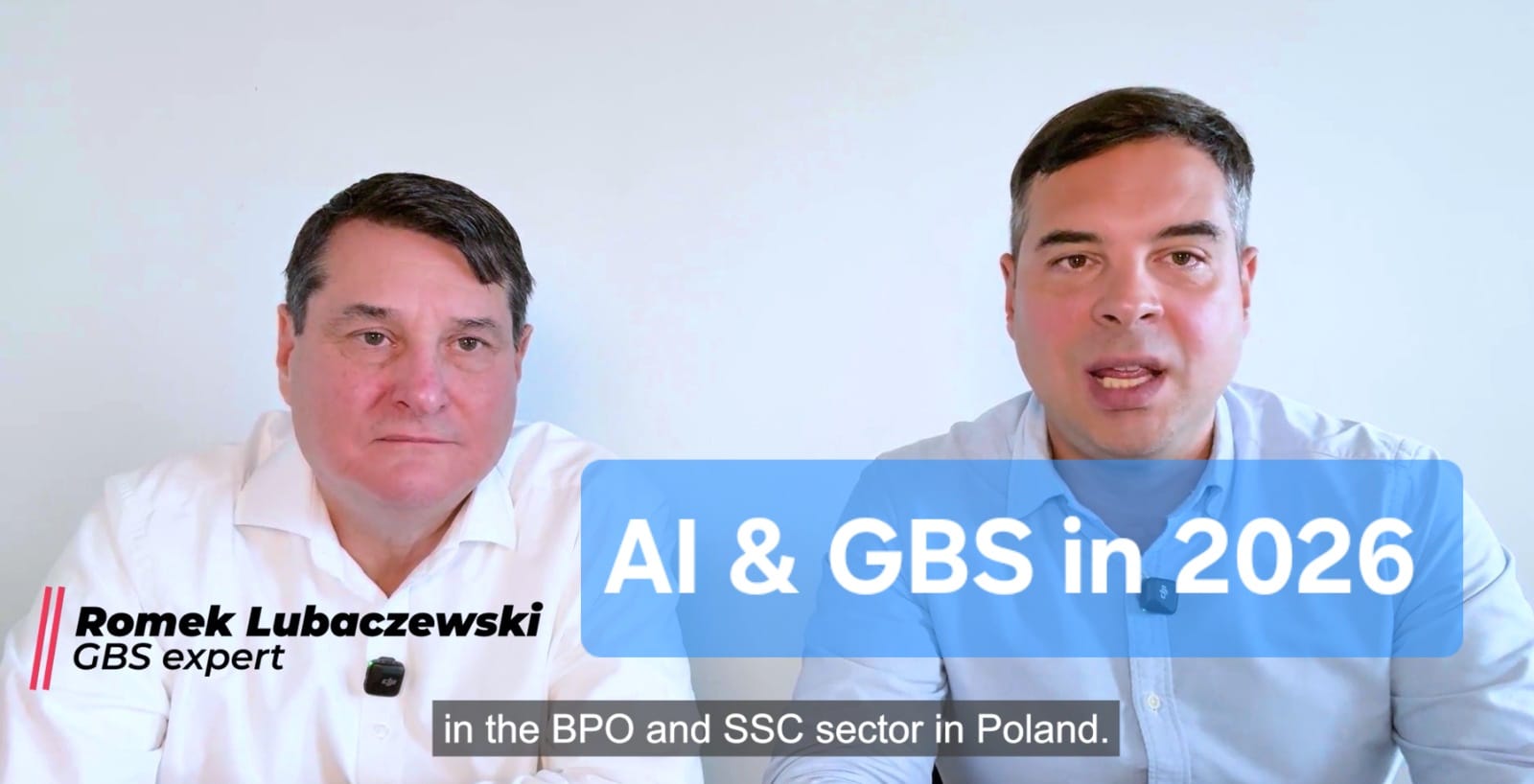
To cut through the noise, Alessandro Lombardi, Director at ITSelecta, sat down for an in-depth conversation with Romek Lubaczewski, a GBS veteran who opened 50+ corporate centers/operations in Poland during his career and is a former PwC Partner.
Alessandro has spent many years working in IT recruitment in Poland, watching the market evolve on both sides: client expectations increasing while candidate availability shifts due to wage pressure, competition, and emerging skill demands. He wanted to understand the full picture—not just the headlines—from someone who has seen every cycle since the industry’s earliest days.
The result is a candid look at what AI will realistically change by 2026, why overnight transformation is a myth, and what leaders must do to stay competitive in Poland, across Europe, and globally.
Work in GBS, from constant growth to cost pressure: a market shift
For decades, shared services in Poland (especially Krakow) benefited from steady expansion. Romek argues that this “constant growth” pattern is ending. He predicts zero growth turning into negative growth over the next 12 months, with potential reductions of 5–10 percent across the market.
The driver isn’t a lack of demand for services—it’s cost pressure. Global headquarters are pushing for budget cuts (Romek uses the example of turning “10 million into 9 million”), and when 75–80 percent of delivery cost is people, the math becomes uncomfortable quickly.
This is where AI enters the conversation—often as a promise executives want to cash immediately.
AI expectations vs AI reality: the 3–5 year truth
One of the most valuable insights from the conversation is Romek’s reality check on AI timelines. He argues that senior executives (particularly in financial centers like New York and London) often expect AI to deliver major savings within 1–2 years. In practice, meaningful productivity improvements are more realistic over 3–5 years, with gains in the range of 20–30 percent total—not “10 percent this year, 10 percent next year.”
This mismatch creates risk. If organizations promise automation savings they cannot deliver, they face pressure to cut headcount instead—damaging capability and morale without achieving sustainable efficiency.
For Europe and the World, the implication is clear: credible roadmaps beat hype. Centers that set realistic expectations and invest in the prerequisites (process standardization, data quality, internal AI capability) will outperform those chasing quick wins.
Outsourcing, insourcing, and the changing contract logic
Alessandro and Romek explore the shifting dynamics of outsourcing contracts. Romek notes that many agreements run 5–7 years, and as renewals approach, companies are rethinking whether to bring work back in-house.
The reasoning is straightforward: if “basic simple stuff” can be automated, why pay an outsourcer to do it with people?
But Romek challenges the fantasy math. Going from “50 people to 5” on a given process is rarely achievable. A more realistic outcome is removing perhaps 10 out of 50—meaningful, but not transformational overnight.
His advice is counterintuitive: in many cases, he would leave work with the outsourcer and push them to automate and reduce price, rather than insource and discover the delivery is harder than expected. Outsourcers often have automation teams at scale; smaller in-house centers may have none.
This creates space for outstaffing as a hybrid model: companies keep strategic control but embed specialized talent (AI delivery, data engineering, process excellence) quickly, without waiting for lengthy permanent hiring cycles.
The opportunity: build AI teams inside GBS
Romek’s most actionable recommendation is to build internal AI capability rather than relying solely on external consultants or vendor promises.
He suggests a concrete approach: propose a dedicated AI team (he uses an example like a “50-person AI team”), growing the center by adding transformation scope rather than transactional volume. This positions the site as a strategic asset rather than a cost center.
The execution model he recommends:
- Train broadly on AI basics across the organization
- Identify high-aptitude individuals who enjoy the work and excel
- Invest heavily in upskilling (he suggests allocating a major share of training budget to AI)
- Create AI champions embedded in operational teams to drive adoption and culture change
- This approach is faster than trying to “buy” scarce AI talent externally—and it builds institutional knowledge that external consultants cannot replicate.
The unglamorous prerequisite: process and data standardization
Romek emphasizes a point that often gets lost in AI enthusiasm: automation doesn’t fix broken workflows. If a process involves excessive back-and-forth, missing approvals, scattered systems, and poor data quality, adding AI won’t magically create efficiency.
The sequence matters:
- Standardize the process (remove waste, clarify steps, reduce exceptions)
- Standardize and consolidate data (definitions, quality, governance)
- Then apply AI/automation and measure real outcomes
- For GBS/SSC/BPO leaders across Europe, this is a competitive differentiator. The best centers will become operational engineering hubs—not just delivery factories.
What leaders should do now: a 2026 action checklist
Based on the conversation between Alessandro and Romek, here’s a practical checklist:
- Plan for flat or negative growth and defend relevance by expanding scope into higher-value work-
- Build a 3–5 year AI roadmap with credible milestones (not hype)
- Invest in internal AI delivery capability (small core team + distributed champions)
- Treat outsourcing and outstaffing as complementary tools—choose based on speed, risk, and capability
- Standardize process and data before promising dramatic automation savings
- Communicate realistic timelines to headquarters to avoid destructive short-term cuts
The conversation between Alessandro Lombardi and Romek Lubaczewski confirms that AI is neither savior nor destroyer for GBS/SSC/BPO—it’s a tool that rewards preparation.
In 2026, success depends on moving up the value chain: toward AI delivery, process engineering, and measurable outcomes.
The centers that adapt will thrive across Poland, Europe, and the World. Those that wait for the old growth model to return will struggle.
About ITSelecta
ITSelecta is a client-centric IT recruitment agency based in Krakow, Poland, with over 10 years of experience connecting top tech talent with companies across Europe.
Specializing in IT recruitment, BPO & SSC recruitment (including finance and customer facing roles), and helping businesses start tech hubs in Poland, ITSelecta delivers vetted candidates in as few as 5 days.
ITSelecta is your trusted partner for navigating the evolving talent market.
📩 Looking to hire AI, data, or automation talent in Poland? Contact ITSelecta at info@itselecta.com
🎬 Watch the full conversation: AI & GBS in 2026: What is changing and why it matters?